
AI in Healthcare Operations and Clinical Workflows | 2026 Guide

AI in Healthcare 2026

AI in Healthcare Operations and Clinical Workflows | 2026 Guide
Healthcare organizations are under increasing pressure as patient demand continues to rise, workforce shortages persist, and operational costs grow year after year. These challenges are forcing hospitals and clinics to rethink how care is delivered while maintaining quality, safety, and efficiency.

By 2026, AI in healthcare has moved far beyond its early use cases in diagnosis and medical imaging. Today, healthcare providers are adopting AI across the entire care continuum. From supporting clinical decision-making and care coordination to automating administrative tasks such as scheduling, documentation, billing, and resource management, AI is becoming an essential part of daily operations. These technologies help reduce manual workload, minimize errors, and enable teams to focus more on patient care.

Importantly, AI is not replacing medical or operational staff. Instead, it is designed to augment human expertise and support healthcare teams where they need it most. By integrating AI into end-to-end workflows, organizations can improve efficiency, streamline operations, and deliver better patient outcomes without compromising trust or clinical judgment.

This guide provides a clear, practical overview of how AI fits into healthcare workflows from intake to follow-up. It explains how hospitals and clinics can implement AI responsibly to support staff, improve performance, and build more resilient healthcare systems for the future.

AI CTA Bharatlogic

Where AI Is Used in Healthcare Today

Where AI Is Used in Healthcare Today

AI supports healthcare organizations in three major areas:

Clinical care:

AI supports clinicians with decision support, patient monitoring, risk detection, and care coordination, improving accuracy and outcomes without replacing medical judgment.

Administrative tasks:

AI automates scheduling, documentation, coding, billing, and prior authorizations, reducing paperwork and easing the administrative burden on staff.

Operational management:

AI helps optimize staffing, resource allocation, capacity planning, and supply chain management, enabling more efficient and cost-effective healthcare operations.

Each area has its own workflow and impact.

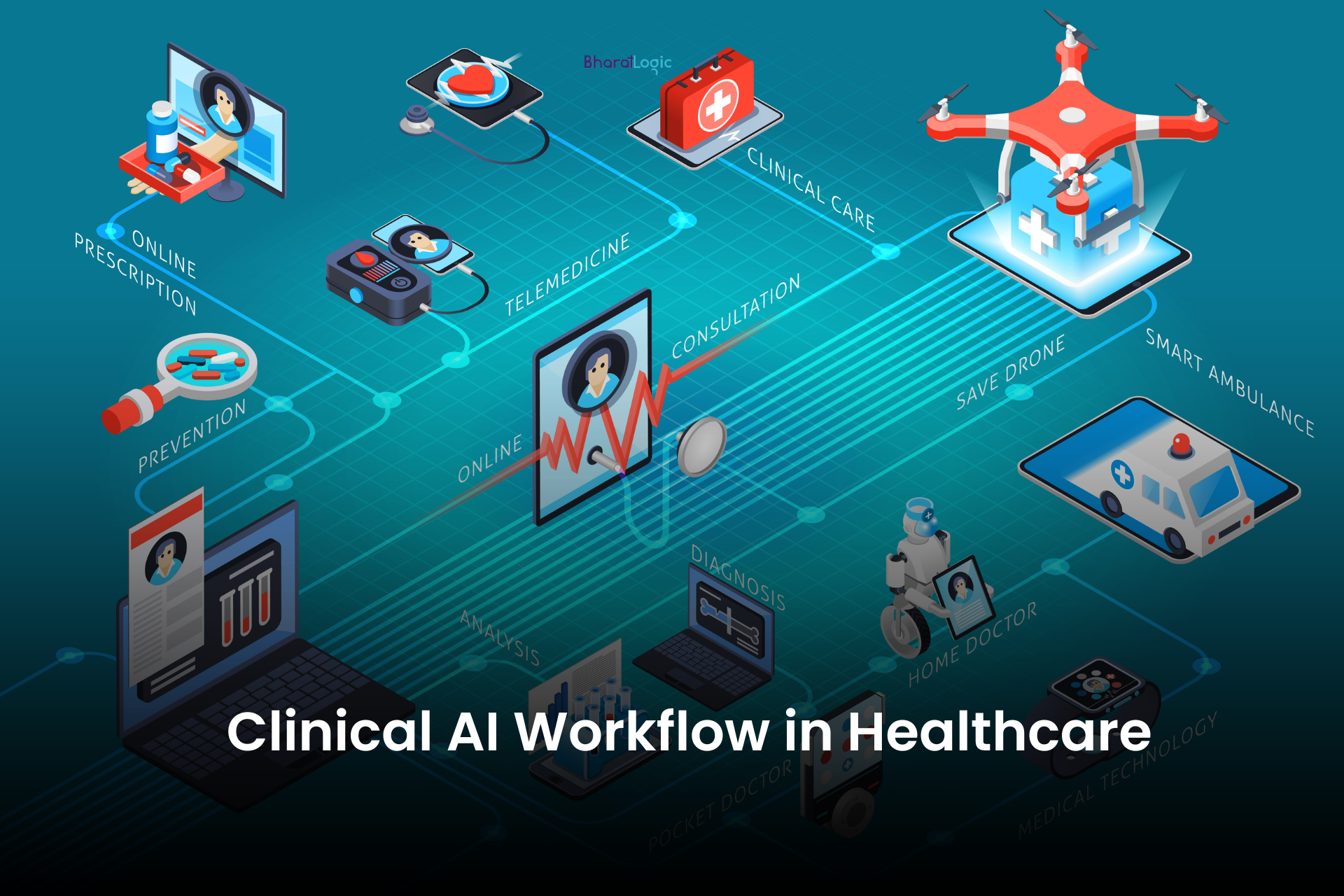
Clinical AI Workflow in Healthcare

Clinical AI Workflow in Healthcare

Step 1: Patient Data Collection

Clinical data is collected from:

Electronic health records (EHRs):

AI uses structured and unstructured data from EHRs, including medical history, diagnoses, medications, and clinician notes, to support decision-making and care planning.

Lab results:

Laboratory data provides timely, standardized inputs that help AI identify trends, flag abnormalities, and support faster, more accurate clinical assessments.

Medical imaging:

Imaging data such as X-rays, MRIs, and CT scans enables AI to assist with pattern recognition, prioritization, and diagnostic support.

Patient intake forms:

Intake data captures symptoms, demographics, and medical history, helping AI personalize workflows and triage patients effectively.

Wearable health devices:

Continuous data from wearables supports monitoring, early risk detection, and proactive care.

AI systems depend on accurate, complete, and well-structured data to generate reliable insights. High-quality data ensures consistent analysis, reduces errors, and improves trust in AI-driven recommendations. Without proper data standards and validation, AI outputs can become unreliable and limit their value in clinical and operational decision-making.

Step 2: Data Processing and Protection

Before analysis:

Data is cleaned and standardized:

Healthcare data is prepared by removing errors, duplicates, and inconsistencies, then converted into standardized formats. This ensures AI systems can accurately analyze information across departments and sources.

Patient identifiers are secured:

Sensitive patient information is protected through encryption, access controls, and anonymization where required, reducing privacy risks and preventing unauthorized use of data.

Compliance requirements are enforced:

Data handling processes follow healthcare regulations such as HIPAA and regional privacy laws, ensuring AI systems operate within legal, ethical, and governance standards.

This ensures patient privacy and data quality.

Step 3: AI Analysis and Pattern Detection

AI models analyze data to:

Identify abnormalities in scans:

AI analyzes medical images such as X-rays, CT scans, and MRIs to detect anomalies that may be difficult to identify manually, helping clinicians prioritize critical cases more efficiently.

Detect early risk indicators:

By analyzing patient history, lab results, and real-time data, AI can recognize early warning signs of disease progression or complications before symptoms worsen.

Support diagnosis and prognosis:

AI provides evidence-based insights that assist clinicians in confirming diagnoses and predicting outcomes, supporting informed clinical decisions while leaving final judgment to medical professionals.

These insights help clinicians act faster.

Step 4: Clinical Decision Support

AI provides recommendations, not decisions.
Doctors use AI outputs to:

Validate findings:

AI cross-references patient data, lab results, and imaging studies to confirm clinical observations, helping ensure that diagnoses and treatment recommendations are accurate and consistent.

Prioritize high-risk patients:

By analyzing patterns in patient data, AI identifies those most at risk of complications or deterioration, allowing healthcare teams to allocate attention and resources where they are needed most.

Reduce diagnostic errors:

AI supports clinicians by highlighting potential oversights, inconsistencies, or unusual patterns, minimizing human error and improving overall diagnostic accuracy, ultimately enhancing patient safety and outcomes.

Human judgment remains central.

Step 5: Treatment and Monitoring

AI supports care delivery by:

Tracking patient response:

AI continuously monitors patient progress during treatment, analyzing clinical data, lab results, and symptom reports to assess how patients are responding to therapies. This helps clinicians adjust care plans quickly for better outcomes.

Monitoring vital signs remotely:

Wearables and connected devices feed real-time data to AI systems, tracking heart rate, blood pressure, oxygen levels, and other vital signs. Remote monitoring enables continuous observation without requiring constant in-person visits.

Sending alerts for early intervention:

AI detects abnormalities or concerning trends and generates timely alerts for clinicians, allowing early intervention, preventing complications, and improving patient safety.

This improves continuity of care.

Administrative AI Workflow in Healthcare

Administrative AI Workflow in Healthcare

Administrative work consumes significant time and resources.

Step 1: Patient Scheduling and Intake

AI automates:

Appointment scheduling:

AI automates the scheduling process by coordinating patient availability with clinician calendars, reducing administrative workload, minimizing scheduling conflicts, and improving clinic efficiency. Patients can book, reschedule, or cancel appointments easily through automated systems.

Pre-visit data collection:

Before visits, AI collects relevant patient information such as medical history, symptoms, and medications via online forms or patient portals. This ensures clinicians have accurate, up-to-date data, allowing more focused and effective consultations.

Follow-up reminders:

AI sends automated reminders for follow-up appointments, medication adherence, or post-visit instructions. This improves patient engagement, reduces missed appointments, and supports continuity of care, ultimately enhancing outcomes.

This reduces front desk load.

Step 2: Documentation and Coding

AI assists with:

Medical documentation:

AI assists in creating accurate and detailed medical records by transcribing clinician notes, summarizing patient encounters, and ensuring consistent documentation. This reduces administrative burden and allows healthcare providers to focus more on patient care.

Clinical coding:

AI analyzes patient records, diagnoses, and procedures to assign the correct codes for billing and reporting. Automated coding improves accuracy, speeds up the process, and reduces errors that could lead to claim denials.

Insurance claim preparation:

AI streamlines claim generation by verifying information, detecting inconsistencies, and ensuring compliance with payer requirements. This accelerates approvals, reduces rejected claims, and enhances revenue cycle efficiency.

Errors are reduced and processing becomes faster.

Step 3: Billing and Claims Processing

AI helps:

Validate claims:

AI reviews insurance claims to ensure all submitted information is accurate, complete, and consistent with patient records and clinical documentation. This validation helps prevent errors before claims are processed, saving time and resources.

Detect billing errors:

By analyzing coding, treatment records, and payer requirements, AI identifies discrepancies, duplicate charges, or incorrect codes that could lead to denials. Early detection minimizes financial losses and ensures compliance with regulations.

Reduce rejection rates:

With accurate validation and error detection, AI significantly lowers the number of rejected or delayed claims. This streamlines the revenue cycle, improves cash flow, and reduces administrative workload for healthcare staff.

This improves cash flow.

Operational AI Workflow in Healthcare

Operational AI Workflow in Healthcare

Operational efficiency directly impacts patient care quality.

Step 1: Resource Planning

AI analyzes historical data to:

Predict patient inflow:

AI analyzes historical data, seasonal trends, and real-time factors to forecast patient admissions and outpatient visits. Accurate predictions help healthcare facilities prepare for varying patient volumes, ensuring resources are available when needed.

Optimize bed allocation:

AI supports efficient bed management by matching patient needs with available beds, considering length of stay, care requirements, and discharge planning. This reduces bottlenecks, prevents overcrowding, and ensures timely admissions.

Improve staff scheduling:

By analyzing patient volume, acuity levels, and staff availability, AI creates optimized schedules that balance workload, minimize overtime, and ensure adequate coverage, enhancing both staff efficiency and patient care quality.

This prevents overloading teams.

Step 2: Supply Chain and Inventory Management

AI supports:

Demand forecasting for medical supplies:

AI analyzes historical usage patterns, seasonal trends, patient volume, and treatment types to accurately predict future demand for medical supplies. This helps hospitals and clinics plan procurement more effectively and avoid shortages or overstock.

Inventory optimization:

By tracking current stock levels, expiration dates, and usage rates, AI ensures that medical supplies are available when needed while minimizing excess inventory. Optimized inventory reduces waste, lowers storage costs, and ensures critical items are always on hand.

Automated reordering:

AI can trigger automatic purchase orders when stock reaches predefined thresholds, streamlining supply chain management, maintaining consistent availability, and freeing staff from manual ordering tasks.

Waste and shortages are reduced.

Step 3: Facility and Equipment Management

AI helps monitor:

Medical equipment usage:

AI monitors how often and how effectively medical equipment is being used, tracking utilization rates and identifying underused or overused devices. This ensures resources are allocated efficiently and equipment supports patient care optimally.

Maintenance schedules:

AI helps plan preventive maintenance by analyzing usage patterns, performance data, and manufacturer recommendations. Timely maintenance reduces unexpected failures, extends equipment lifespan, and ensures compliance with safety standards.

Downtime risks:

By predicting potential equipment failures or malfunctions, AI alerts staff to take proactive action, minimizing operational disruptions, preventing delays in patient care, and maintaining smooth clinical workflows.

This improves reliability and safety.

Step 4: Operational Performance Monitoring

AI dashboards track:

Patient wait times:

AI analyzes appointment schedules, patient flow, and staffing levels to identify bottlenecks and reduce delays. By optimizing scheduling and predicting high-demand periods, AI helps minimize wait times, improving patient satisfaction and overall experience.

Throughput efficiency:

AI streamlines clinical and operational workflows, ensuring patients move smoothly from check-in to discharge. By coordinating tasks, prioritizing cases, and predicting care needs, it enhances the speed and effectiveness of service delivery.

Resource utilization:

AI monitors the use of staff, equipment, and facilities, identifying under- or over-utilized resources. Optimizing allocation improves efficiency, reduces costs, and ensures healthcare teams and infrastructure are used effectively.

Leaders get real time visibility into operations.

Real Benefits of AI Across Healthcare Operations

Benefits of AI Across Healthcare Operations

Organizations adopting AI in healthcare are realizing significant benefits across clinical and operational domains:

Reduced operational costs:

AI automates repetitive administrative tasks, optimizes resource allocation, and streamlines workflows, helping hospitals and clinics lower expenses without compromising care quality.

Better staff productivity:

By handling documentation, billing, scheduling, and routine monitoring, AI frees clinicians and administrative staff to focus on patient care and critical decision-making, improving overall efficiency.

Faster patient turnaround:

AI predicts patient flow, optimizes appointment scheduling, and streamlines clinical processes, reducing wait times and enhancing throughput across departments.

Improved patient experience:

Personalized care, proactive monitoring, and timely interventions enabled by AI lead to higher patient satisfaction, better engagement, and stronger trust in healthcare providers.

More consistent care delivery:

Evidence-based AI insights support standardized procedures, minimize errors, and ensure uniform care quality across teams and locations.

The biggest gains come from combining clinical AI such as diagnostic support, early risk detection, and treatment recommendations with operational AI that optimizes scheduling, staffing, and resource management. Together, they create an integrated system that improves efficiency, patient outcomes, and staff satisfaction, enabling healthcare organizations to deliver smarter, faster, and more reliable care.

Data Privacy and Compliance Considerations

Data Privacy and Compliance Considerations

Healthcare AI operates in a highly sensitive environment where patient safety, privacy, and trust are paramount. To be effective and ethical, AI systems must meet strict standards across multiple areas:

Secure data handling:

Patient information is among the most sensitive data types. AI systems must encrypt data, control access, and anonymize information where appropriate. Secure handling prevents unauthorized access and protects patient confidentiality.

Regulatory compliance:

Healthcare AI must adhere to local and international laws such as HIPAA, GDPR, and other healthcare regulations. Compliance ensures that AI is used legally and ethically, minimizing legal and reputational risks for organizations.

Audit trails:

Maintaining detailed logs of AI actions, decisions, and data usage is critical. Audit trails allow organizations to trace decisions, verify system accuracy, and demonstrate accountability in case of errors or disputes.

Human oversight:

AI should augment, not replace, clinical judgment. Human professionals must review AI recommendations, validate outcomes, and make final decisions, ensuring that care remains patient-centered and ethical.

Adopting responsible AI practices builds trust among clinicians, administrators, and patients. When AI is secure, compliant, transparent, and supervised, it becomes a reliable partner in healthcare, supporting better outcomes while upholding the highest ethical and professional standards.

How BharatLogic Helps Healthcare Organizations

BharatLogic works with healthcare providers to:

Design end-to-end AI workflows:

BharatLogic creates AI workflows tailored to clinical and operational processes, ensuring seamless integration across departments.

Integrate AI with existing systems:

Their solutions work smoothly with current hospital software and IT infrastructure, avoiding disruption to ongoing operations.

Ensure security and compliance:

Patient data is protected, and all deployments adhere to healthcare regulations and industry standards.

Deploy solutions at affordable rates:

BharatLogic focuses on cost-effective AI implementation, making advanced technology accessible to healthcare providers of all sizes.

Practical adoption with measurable results:

Our approach focuses on practical adoption that delivers measurable results without disruption.

LOOKING TO IMPROVE CLINICAL AND OPERATIONAL EFFICIENCY WITH AI IN 2026?

Book a free consultation with BharatLogic.

We help healthcare organizations adopt AI safely, effectively, and at affordable rates.