
How Much Does Mobile App Development Cost in 2026? A Complete Pricing Breakdown
Mobile app development cost in 2026 typically runs from $15,000 to $300,000+, depending on what you’re building, who builds it, and where they’re based. A simple MVP with a handful of screens might land under $50K. A complex, multi-platform app with AI features and heavy backend work can cross $150K without much effort.
If that range feels useless, you’re not wrong. The problem is that most cost articles throw out a number without telling you what’s inside it. This post breaks down the actual cost drivers so you can figure out where your project lands and sanity-check any quote you receive.
Here’s the quick version before we get into the details.
Quick-Answer: Mobile App Development Cost by Complexity (2026)
All ranges below assume typical agency rates of $80–$150/hr. Rates vary significantly by region. We cover that further down.
| Complexity | What's Included | Timeline | Typical Cost |
|---|---|---|---|
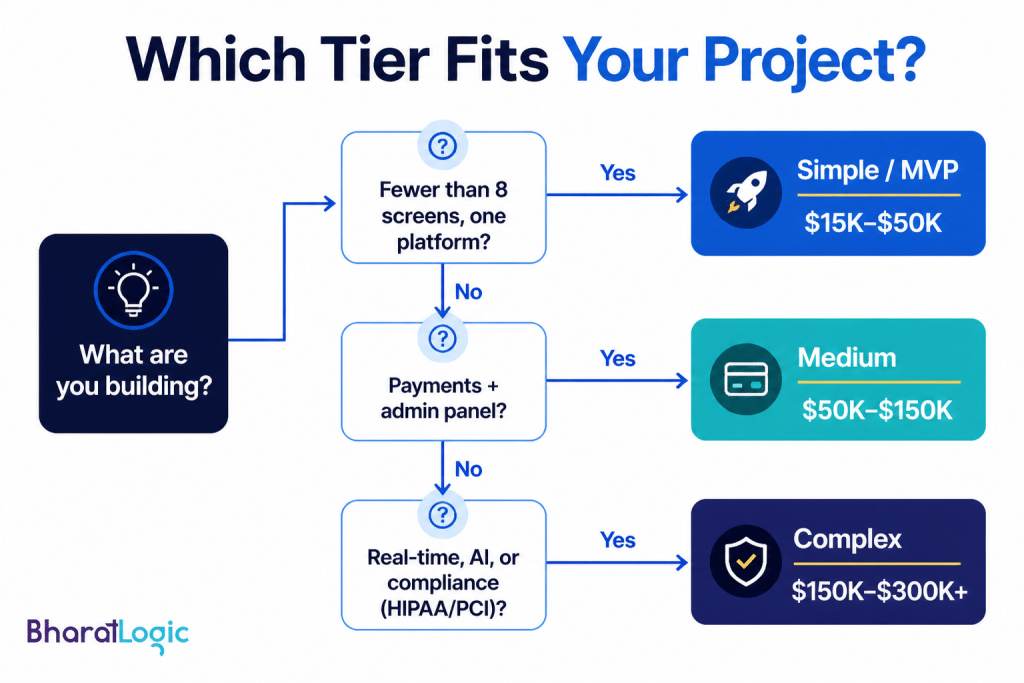
| Simple / MVP | 5–8 screens, basic authentication, one platform, minimal backend | 2–4 months | $15,000–$50,000 |
| Medium | 10–20 screens, payments, push notifications, API integrations, admin panel |
4–7 months | $50,000–$150,000 |
| Complex / Enterprise | Multi-platform, real-time features, AI/ML, custom backend compliance (HIPAA, PCI) |
7–12+ months | $150,000–$300,000+ |
These tiers are benchmark estimates based on common industry ranges. Your actual number will shift based on the factors we cover below.
Why Every Source Gives You a Different Number
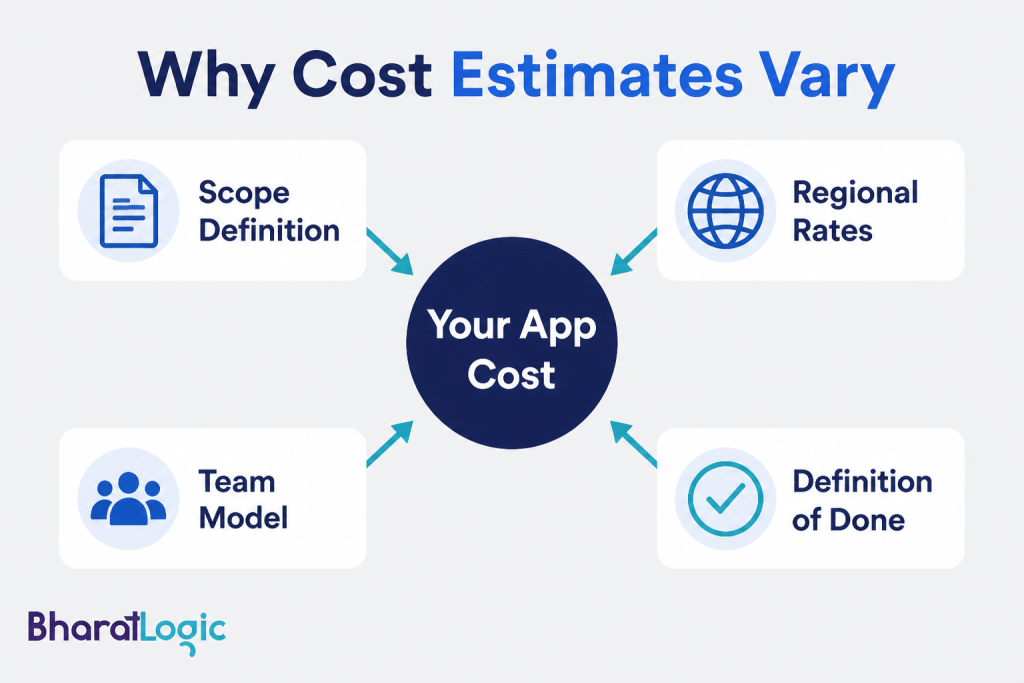
Scope definitions aren’t standardized
One agency’s “simple app” is a five-screen prototype with no backend. Another’s is a fully tested, single-platform product with user accounts and a CMS. There’s no industry-wide rubric for complexity tiers, so a $30K estimate from one vendor and an $80K estimate from another might describe completely different deliverables.
It gets stranger. Even within a single published cost guide, you’ll sometimes find two tier tables for the same year with different upper and lower bounds. One section might list the “enterprise” tier starting at $50K, another at $150K. If a single article can’t stay consistent with itself, you can imagine how much noise there is across the whole web.
Regional hourly rates vary by 5x or more
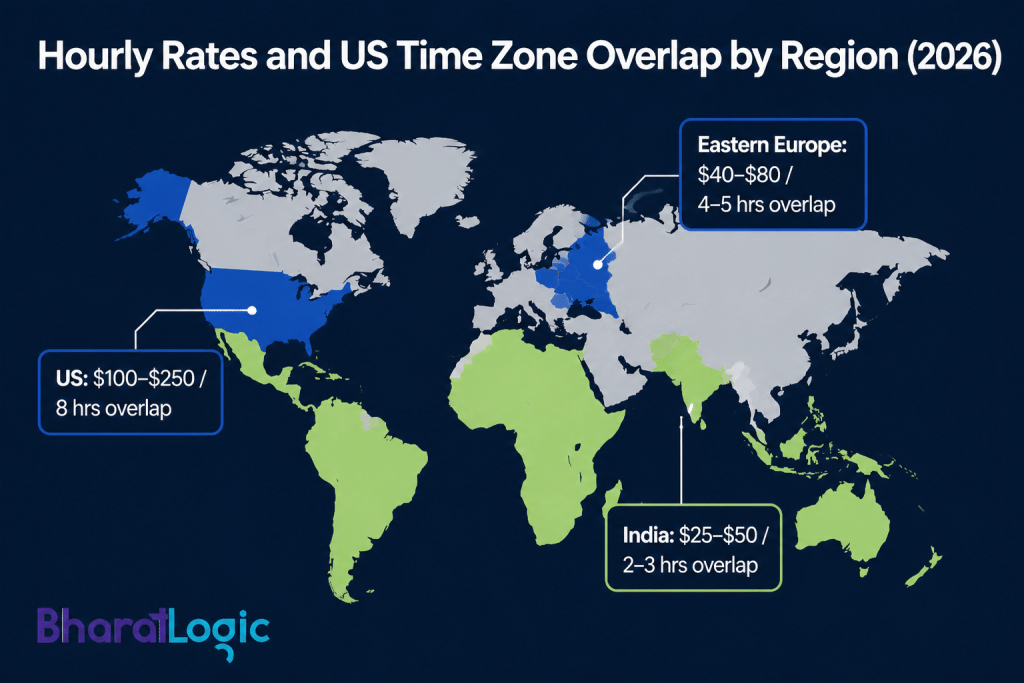
A senior iOS developer in San Francisco bills $150–$250/hr. A developer with comparable skills in Mohali or Warsaw might bill $25–$80/hr. The app they build could be similar, but the invoices will look nothing alike. Most cost articles don’t tell you which rate they’re assuming, which makes their totals hard to compare.
Team model changes the math
Hiring a solo freelancer on a fixed-price contract is a different financial proposition than engaging a full-service agency with a project manager, designer, QA engineer, and DevOps specialist. The freelancer tends to be cheaper upfront. The agency absorbs more delivery risk and handles more of the work you’d otherwise manage yourself.
“Done” means different things
Some estimates cover design, development, and launch. Others stop at a working prototype. Very few include the first year of maintenance, app store compliance updates, or the backend infrastructure you’ll need to keep the thing running. A $40K quote that excludes hosting, monitoring, and bug fixes costs more than it looks.
Mobile App Development Cost by Complexity
Let’s dig into the three tiers from the table above. These ranges assume the same $80–$150/hr agency rate basis. Native-only or offshore builds will shift the numbers, and we’ll show how further down.
Simple apps and MVPs ($15,000–$50,000)
A simple app typically has 5 to 8 screens, email or social login, a basic backend (often a BaaS like Firebase), and one or two core features. Think of an internal field-reporting tool, a content app with push notifications, or a proof-of-concept you want to test with real users before committing to a full build.
The cost to build an MVP app in this range gets you a working product on one or two platforms, but it won’t include advanced features like real-time sync, complex payment flows, or AI. Expect a timeline of 2 to 4 months.
If you’re at the budgeting stage and want a rough number for your specific idea, talk to our team about a free scoping call. We’ll review your requirements and come back with a ballpark estimate.
Medium-complexity apps ($50,000–$150,000)
This is where most startup and SMB apps land. You’re looking at 10 to 20 screens, user roles and permissions, payment gateway integration (Stripe, Braintree), push notifications, an admin dashboard, and at least one third-party API integration.
A medium app usually takes 4 to 7 months from kickoff to launch. The wider cost range reflects choices like native vs cross-platform, the number of integrations, and whether you need an admin panel with reporting.
Complex and enterprise apps ($150,000–$300,000+)
Complex apps involve real-time data (chat, live tracking), AI or machine learning features, multi-tenant architectures, compliance requirements like HIPAA or PCI DSS, and custom backend systems that handle significant scale.
Timelines stretch to 7–12 months or more. At this level, the app development cost is driven less by the number of screens and more by the engineering challenges behind them: data security, uptime guarantees, third-party system integrations, and performance under load.
Cost Breakdown by Feature
Complexity tiers give you a ballpark. Feature-level pricing helps you understand what’s eating your budget. The table below shows estimated cost add-ons for common features, based on the same $80–$150/hr agency rate basis.
| Feature | Complexity | Estimated Cost Add-On |
|---|---|---|
| User authentication (email, social, 2FA) | Low | Approx. $2,000–$5,000 |
| Push notifications | Low | Approx. $1,500–$3,000 |
| Payment gateway (Stripe, Braintree) | Medium | Approx. $3,000–$7,000 |
| Real-time chat or messaging | High | Approx. $8,000–$15,000 |
| Maps and geolocation | Medium | Approx. $3,000–$6,000 |
| Camera, photo, and video integration | Medium | Approx. $4,000–$8,000 |
| Admin panel and analytics dashboard | Medium–High | Approx. $8,000–$20,000 |
| Offline mode with data sync | High | Approx. $6,000–$12,000 |
| AI chatbot or virtual assistant | High | Approx. $10,000–$30,000 |
| Recommendation engine (ML-based) | High | Approx. $15,000–$40,000 |
These are estimates, and they’re additive. A medium app with payments, push notifications, and an admin panel will cost more than the base tier suggests. Use this table as a rough guide for what happens when you add “just one more feature” to your scope.
Native vs Cross-Platform: How Platform Choice Affects Your Budget
The platform decision is one of the biggest levers on your total cost.
iOS-only or Android-only
Building for a single platform with native code (Swift for iOS, Kotlin for Android) gives you the best performance and the deepest access to device hardware. It’s the right call when your users are overwhelmingly on one platform, or when you need advanced features like ARKit or heavy Bluetooth integration.
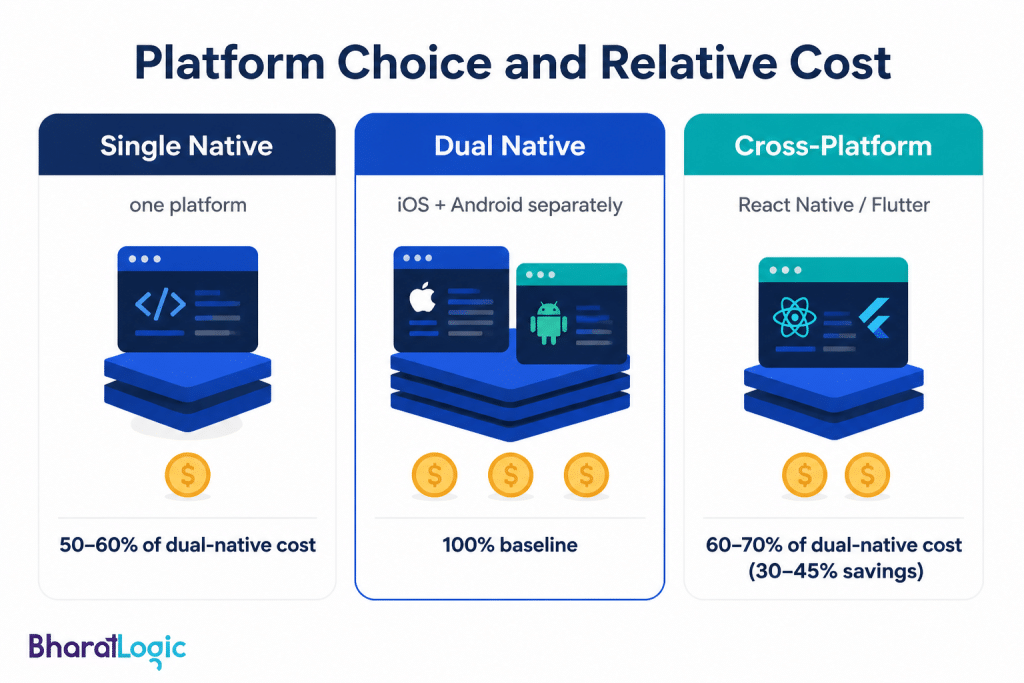
Budget-wise, a single native platform is commonly cited at roughly 50–60% of what a dual-native build would run.
Both platforms, native code
Writing separate codebases for iOS and Android essentially doubles your front-end development effort. You’ll need two development teams, two QA cycles, and two sets of ongoing maintenance. This approach makes sense for apps where performance and platform-specific UX are non-negotiable: high-end gaming, complex media editing, or apps that push the limits of device hardware.
Dual-native is our baseline (100%) for the comparisons here.
Cross-platform (React Native, Flutter)
Cross-platform frameworks let you share a large portion of your codebase between iOS and Android. For most business apps (e-commerce, SaaS dashboards, health-tech tools, booking platforms), the performance difference from native is often negligible, and the cost savings are real.
A cross-platform build is commonly cited at about 60–70% of dual-native cost, which works out to roughly 30–45% in savings. That’s a common reason teams choose React Native for business apps where native-level performance isn’t a hard requirement.
One caveat: cross-platform doesn’t mean you write once and forget about it. You’ll still need platform-specific testing, and some features (deep OS integrations, complex animations) may require native modules that add cost back in.
How Team Location and Hiring Model Change the Price
Hourly rates are the single biggest variable in your mobile app development cost. Here’s what the market looks like in 2026, based on commonly cited industry ranges.
| Region | Typical Hourly Rate | Notes |
|---|---|---|
| United States | $100–$250 | Highest rates; deep talent pool; same time zone |
| Western Europe (UK, Germany, Netherlands) | $80–$150 | Comparable quality to US; 5–8 hour time difference |
| Eastern Europe (Poland, Ukraine, Romania) | $40–$80 | Strong engineering culture; moderate time zone overlap with US East Coast |
| India | $25–$50 | Largest talent pool; significant cost advantage; 9.5–13.5 hour time difference from US |
| Southeast Asia (Vietnam, Philippines) | $20–$40 | Growing market; variable quality; similar time zone challenges to India |
Freelancer vs agency vs dedicated team
A freelancer might charge $30–$80/hr and work alone. That’s fine for a small MVP or a specific feature build. But you become the project manager, the QA department, and the person who figures out what happens when they get sick during a critical sprint.
An agency gives you a team (PM, designer, developers, QA) and takes on delivery risk. Rates are higher per hour, but the total project cost tends to be more predictable because scope changes and rework are managed through a structured process.
A dedicated team model sits in between. You hire a team through a vendor but manage them directly. This works well when you have a technical lead on your side who can set priorities and review code.
The real trade-offs
Lower rates are appealing, and the savings are real. Cost isn’t the only variable, though. Time zone differences can slow down feedback loops. Communication styles vary. Quality ranges widely within every region. A $25/hr developer in India might outperform a $120/hr developer in the US, or the opposite.
The best approach is to evaluate vendors on the quality of their past work, their communication practices, and their willingness to do a paid discovery phase before committing to a full build. The hourly rate matters, but it’s a multiplier on hours. A team that writes clean code the first time will bill fewer hours than one that doesn’t.
The Hidden Costs Most Estimates Leave Out
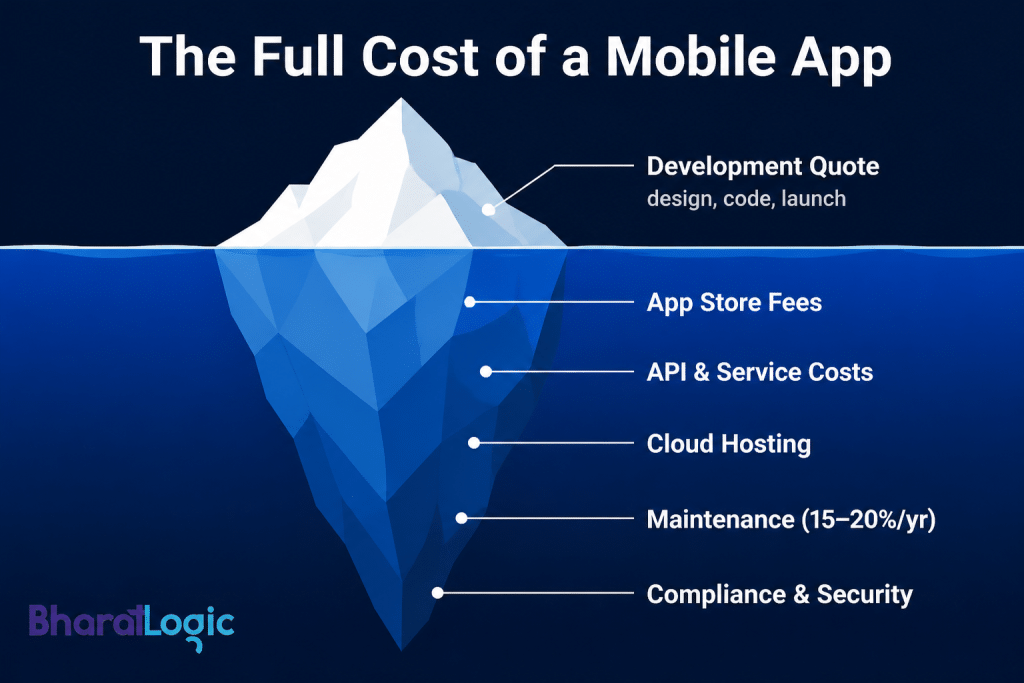
The number on a proposal is rarely the final number. Here’s what tends to show up after launch.
App store fees and compliance
Apple charges $99/year for its Developer Program. Google Play charges a one-time $25 registration fee. These are small line items, but they’re recurring (Apple) and required if you want to distribute through official channels.
Third-party APIs and services
Every external service you integrate has a cost. Twilio for SMS. Stripe for payments, with standard online pricing of 2% per successful domestic card charge and 3% for international cards. AWS or Firebase for hosting and databases. SendGrid for transactional emails. Individually, these are modest. Together, they can add several hundred to several thousand dollars per month to your operating costs depending on usage volume.
Backend, cloud hosting, and infrastructure
Your app needs a server somewhere. A simple app with light traffic might run on a managed backend for a modest monthly cost. A complex app with real-time data, file storage, and high availability requirements can run into the low-to-mid four figures per month on cloud infrastructure before you factor in DevOps time.
Ongoing maintenance and updates
The commonly cited figure for app maintenance cost is 15–20% of the initial build cost per year. For a $100K app, that’s $15K–$20K annually. This covers OS version updates (Apple and Google push new requirements every year), bug fixes, security patches, minor feature updates, and monitoring.
It’s not optional. Apps that aren’t maintained get removed from stores, break on new OS versions, and accumulate security vulnerabilities.
Security and regulatory compliance
If your app handles health data, payment data, or EU user data, compliance is an ongoing engineering and legal effort. For reference points:
- Healthcare apps handling protected health information fall under HIPAA. See the HHS summary of the HIPAA Security Rule for what’s required.
- Apps handling card payments must meet PCI DSS requirements published by the PCI Security Standards Council.
- Apps serving EU users fall under GDPR. The official European Commission GDPR overview is a good starting point.
For budgeting, compliance work for a medium-complexity app commonly adds a line item in the range of $15,000–$50,000+ depending on scope, including security audits, penetration testing, encryption implementation, and legal review.
Mobile App Development Timeline and How It Drives Cost
Time is money, literally. Every additional month of development adds labor costs, delays revenue, and increases the chance that market conditions shift under your feet.
| Complexity | Typical Timeline | Key Phases (Phases Often Overlap) |
|---|---|---|
| Simple / MVP | 2–4 months | Discovery (2–3 wks), design (3–4 wks), development (6–10 wks), QA and launch (2–3 wks) |
| Medium | 4–7 months | Discovery (3–4 wks), design (4–6 wks), development (12–20 wks), QA and launch (3–5 wks) |
| Complex | 7–12+ months | Discovery (4–6 wks), design (6–8 wks), development (20–40 wks), QA and launch (4–8 wks) |
In practice, these phases overlap significantly. Design continues into development, QA runs in parallel with later development sprints, and discovery findings get revisited as the product takes shape. The totals above reflect calendar time from kickoff to launch, not the sum of phase durations.
Rush timelines are possible but expensive. Compressing a 6-month project into 3 months usually means adding more developers, which increases coordination overhead and can actually slow things down past a certain point. Brooks’s Law is real. Expect a cost premium for accelerated delivery, though the exact size depends on how aggressively you compress and how parallelizable the remaining work is.
How Much Does It Cost to Add AI to a Mobile App?
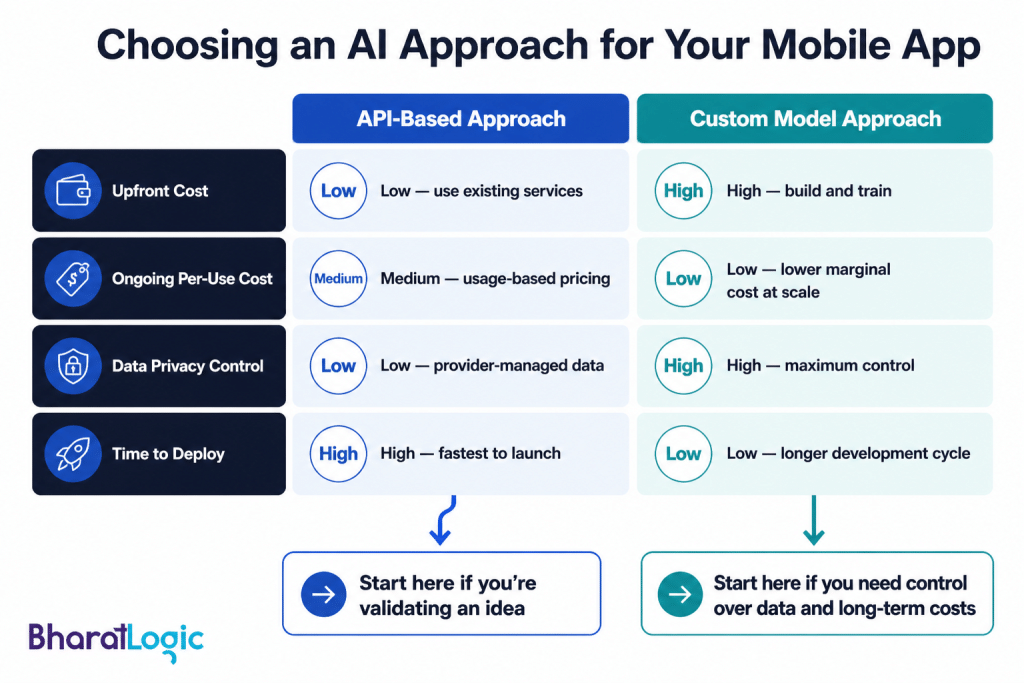
AI features are the fastest-growing line item in mobile app budgets. The cost to add AI to an app depends heavily on whether you’re using a pre-built API or training a custom model.
| AI Feature | Approach | Estimated Cost |
|---|---|---|
| AI chatbot (customer support) | Pre-built API + custom UI | Approx. $10,000–$25,000 |
| Recommendation engine | ML model trained on your data | Approx. $15,000–$40,000 |
| Image or document recognition | Pre-trained model (Google Vision, AWS Rekognition) + integration | Approx. $8,000–$20,000 |
| Voice recognition / NLP | API integration + custom training | Approx. $12,000–$30,000 |
| Custom LLM wrapper | Third-party LLM API integration, prompt engineering, guardrails, data pipeline | Approx. $20,000–$50,000+ |
The API-based options are cheaper upfront but come with ongoing per-call costs that scale with your user base. A custom model costs more to build but gives you control over accuracy, data privacy, and long-term operating costs.
We’ve been building AI and ML integrations into mobile apps for. A useful mental model: AI features are systems, not single features. A chatbot isn’t just a text box. It needs prompt engineering, fallback logic, content moderation, and monitoring to work reliably in production.
Industry-Specific Cost Factors
Your industry shapes your app’s cost more than you might expect, mostly through compliance and integration requirements.
Healthcare and health-tech
HIPAA compliance alone can add meaningfully to your development budget, typically in the range of $15,000–$50,000+ for a medium-complexity app. You’ll need encrypted data storage, audit logging, role-based access controls, and a Business Associate Agreement with every vendor that touches patient data.
Fintech
Payment apps and financial tools require PCI DSS compliance, end-to-end encryption, KYC/AML integrations, and real-time fraud detection. The engineering bar is higher, and so is the QA effort. Budget a meaningful premium over a comparable non-fintech app.
E-commerce
E-commerce apps need payment gateway integrations, inventory management sync, order tracking, and often a headless CMS for product catalogs. The complexity scales with your SKU count and the number of fulfillment channels you support.
SaaS and analytics tools
Analytics-focused apps often involve SDK integrations, custom dashboards, and backend data pipelines that aggregate and visualize user data. The front-end screen count can be modest, but the backend work and third-party integration work typically drives the budget.
How to Sanity-Check Any App Development Quote
You’ve collected a few proposals. The numbers are all different. Here’s how to figure out which one is realistic.
1. Ask what’s included in the scope. Does the quote cover design, development, QA, project management, and launch? Or just development? A $40K quote that excludes design and testing isn’t cheaper than an $80K quote that includes everything.
2. Check the assumptions. How many screens? How many user roles? Which platforms? What happens when you need to change something mid-project? A good proposal spells these out explicitly.
3. Look for a discovery phase. Vendors who jump straight to a fixed price without understanding your requirements are guessing. A paid discovery phase (typically 2–4 weeks, $5K–$15K) [NEEDS DATA] produces a detailed spec that makes the final quote far more reliable.
4. Ask about post-launch costs. Maintenance, hosting, app store updates, third-party API fees. If the proposal doesn’t mention these, ask. They’re not optional, and they’ll hit your budget whether the vendor told you about them or not.
5. Compare team composition, not just totals. A quote from a team of two developers and a project manager describes a different product than one from a team of six with a dedicated QA engineer and a UX designer.
6. Watch for red flags. Suspiciously low fixed prices. Vague scope documents. No mention of testing. Promises of a “guaranteed” timeline with no risk buffer. These often mean the vendor plans to charge you for change orders later.
7. Request references for similar projects. Ask to see apps they’ve shipped in your industry or at your complexity level. Download the apps. Try them. Ask the references about communication, timeline accuracy, and post-launch support.
Frequently Asked Questions
A simple app starts around $15,000–$50,000. A medium-complexity app with payments, notifications, and an admin panel typically runs $50,000–$150,000. Complex apps with AI, real-time features, and compliance requirements can exceed $150,000–$300,000. The final number depends on your features, platform choice, and team location.
It depends on your business model and budget. If an app is core to your product (a SaaS tool, a marketplace, a health platform), the investment usually pays off through user retention and revenue. If you just need a mobile presence, a responsive web app can be a better first step at a fraction of the cost.
AI tools like ChatGPT and Cursor can generate boilerplate code, prototype screens, and speed up development significantly. A production app still needs professional UX design, security hardening, QA testing, app store compliance, and ongoing maintenance. Think of AI as a productivity multiplier for your development team rather than a replacement for one.
This varies by state, your revenue model, and your liability exposure. Many founders launch as sole proprietors and form an LLC later. We’re not attorneys, so we’d recommend speaking with a business lawyer or accountant who understands your specific situation before making this decision.
Ready to figure out what your app will actually cost? We offer a free scoping call where we’ll review your requirements, flag potential cost drivers, and give you a ballpark estimate. No commitment required. Get in touch with our team and we’ll follow up to schedule a time.
Share the article: